Over the years I’ve thought a lot about what happens to my Spotify account when I stop paying for it. Not leaving, I don’t have a plan to leave, but the realisation that everything I’ve built there exists entirely at Spotify’s discretion. Eight years of playlists. Hundreds of them. A record of who I’ve been listening to and when, assembled without me quite noticing I was assembling it. If the account gets deleted, or the service folds, or the terms change in a way I don’t like, all of it goes with it.
I tried to move platforms before. Amazon Music and Apple Music are fine for what they are, but for the specific corners of electronic music I listen to—organic house, downtempo, the stuff that never charted anywhere—the catalogues thin out fast. Most of it lives on SoundCloud or Mixcloud, which I don’t pay for, which means Spotify remains the best available option for the breadth of what I actually want. I’m not trapped exactly. It’s more that the lock-in is real and I’ve accepted it, but the idea that accepting it means surrendering the history I’ve built there didn’t sit right.
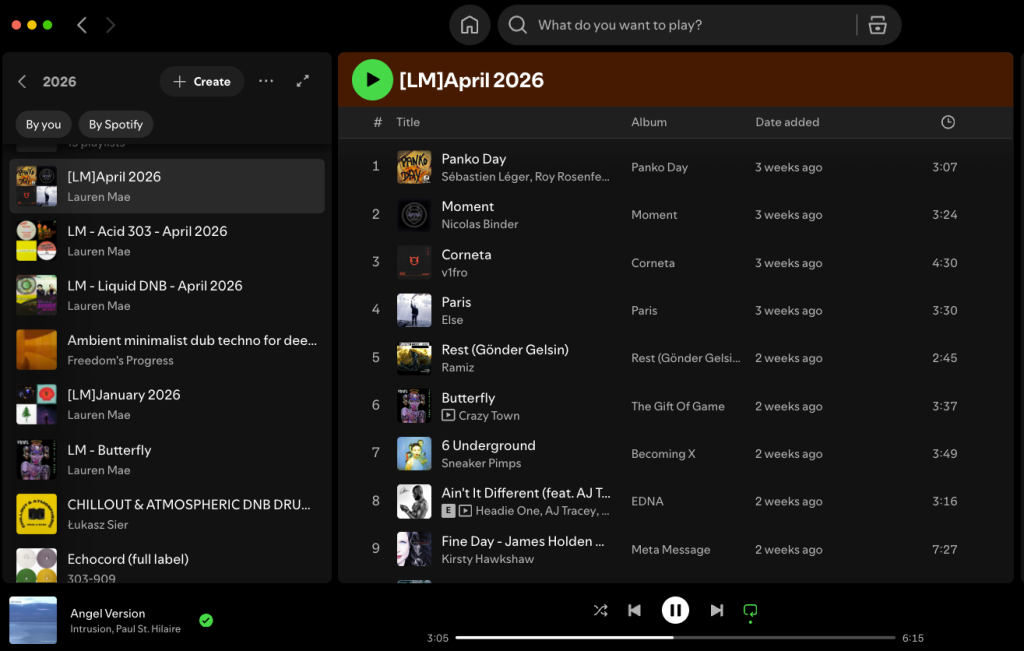
So I decided to export everything. And if I was extracting it anyway, I might as well actually look at it.
The tool that makes this possible is Exportify, a free web app that connects to your Spotify account and exports every playlist as a CSV. Most people who know about it use it as a backup. What I didn’t realise until I ran it is that Exportify doesn’t just give you track names and artists. It gives you Spotify’s full audio feature set for every track: Energy, Danceability, Valence, Instrumentalness, Tempo, Key, Genres, Record Label. A complete sonic fingerprint for every song you’ve ever saved.
I exported everything, then gave it all to Claude and asked it to find the patterns.
What the archive looks like
142 playlists. 3,018 unique tracks. 4,856 total appearances. Eight years: 17 July 2018 to 28 April 2026. 79 active months out of 94, which means 15 genuine gaps, months where nothing was added anywhere in the archive.
The most active month is June 2023, at 1,044 tracks. That number is immediately suspicious. It’s more than the next busiest months combined, and it doesn’t match any obvious period of intense listening I can place. Something happened there—a migration, a bulk import, something—and it’s an anomaly I want to dig into properly in part two when the full streaming history arrives.
The playlists fall into a loose taxonomy that emerged without being planned: monthly journals named by date, vibe and mood playlists, genre explorations, artist deep-dives. I wasn’t intentionally trying to build an archive; I was just making playlists, and the archive built itself around me.
2018–2019: where it started
Small sample—35 tracks in 2018, 170 in 2019—but the signal is clear.
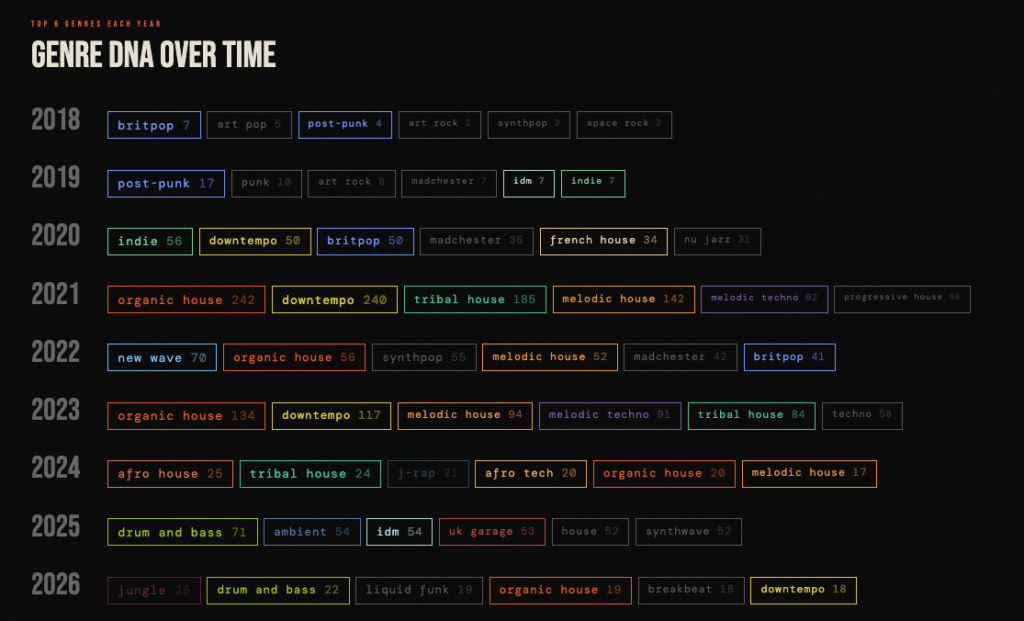
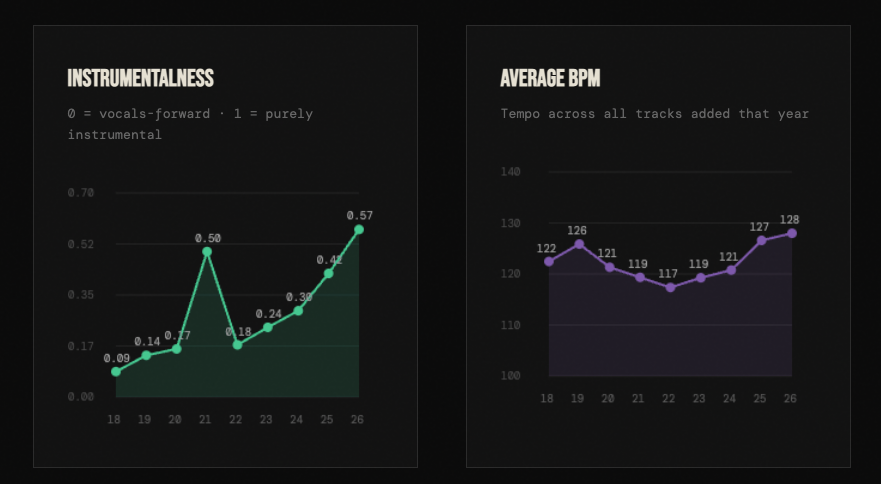
Britpop. Post-punk. Art rock. Madchester. IDM. Guitar-led, lyric-heavy, and strikingly vocal-forward: an Instrumentalness score of 0.09, which is about as low as it goes. The music had to say something. The Smiths. The Libertines. Pulp.
It’s the listening of someone who needs the words to be the point. Music as a set of references, a set of positions.
2020: the hinge year
Volume explodes: 832 tracks, the most active year to that point by distance. April 2020 alone saw 380 tracks added, a spike that needs no explanation.
Indie and Britpop were still dominant, but French house, French indie pop, and downtempo were beginning to appear alongside them. Nu jazz entered the picture. The palette was quietly widening while the core held. Instrumentalness barely moved—from 0.087 to 0.165—still vocal-forward, still needing the narrative.
In retrospect this is the last year of the old taste. At the time it just felt like having more time to listen.
2021: the pivot
The most important year in the archive, and the data makes that unmistakable.
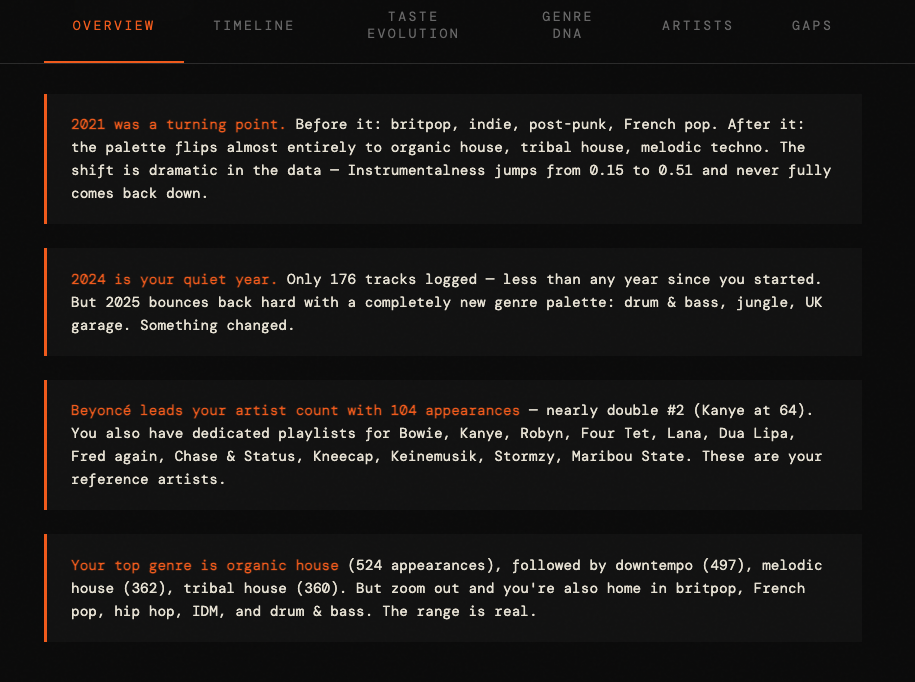
Organic house and downtempo essentially took over—242 and 240 appearances respectively. Tribal house (185), melodic house (142), melodic techno (92) completed the picture. The guitar music became a footnote.
Instrumentalness moves from 0.165 to 0.499 in a single year.
The biggest single data point in the whole archive. I stopped needing lyrics almost overnight. Energy dipped slightly, from 0.696 to 0.638—the music wasn’t getting more aggressive, it was getting more hypnotic.
Part of this has a straightforward explanation. I’d been spending time in South East Asia, where the events I was going to were entirely electronic, no crossover, no compromise. You absorb what you’re surrounded by. But I don’t think that’s the whole story, because the shift didn’t reverse when circumstances changed. Something settled.
2022: the wobble—or the full picture
New wave and synthpop resurfaced. Rap and hip hop came back in—Dua Lipa, Sean Paul, Kylie Minogue all prominent. Instrumentalness dropped back to 0.179. The pop sensibility reasserted itself.
The easy reading is a reversion. What I think is actually more accurate: 2022 showed what had always been true. The pop taste and the electronic identity had been running in parallel the whole time. 2021 didn’t replace one with the other, it just moved the dial far enough that you could see the gap. The house and techno thread never disappeared in 2022. It just coexisted.
874 tracks. A high-volume year, actively engaged with both selves.
2023: consolidation
Organic house, downtempo, and melodic techno reasserted dominance. The 2021 taste was back and settled, less like a discovery, more like a home. 1,348 tracks in total, with the June anomaly inflating that number considerably.
2024: the quiet year
136 tracks.
After years of 800-plus, a cliff. No obvious genre story: afro house, tribal house, some J-rap. Four months of total silence: January, March, April, July. The most significant gap cluster in the entire archive.
What the data does show: what I did listen to that year was more physical, more groove-oriented than ever. And Instrumentalness kept climbing to 0.248, the trajectory didn’t reverse, it just slowed to almost nothing.
The data doesn’t know why 2024 was quiet. I’m not sure I do either, not completely.
2025–2026: something new
The current palette is barely recognisable from 2018.
Drum & bass (71 appearances). UK garage (53). Ambient (54). IDM (54). Jungle, synthwave, breakbeat. Playlists built around Chase & Status, Kneecap—none of whom appear anywhere in the earlier archive.
Instrumentalness: 0.424 in 2025, 0.575 in 2026—the highest it’s ever been, still climbing. BPM: 126.6 in 2025, 128.0 in 2026.
Literally getting faster every year since 2022.
From britpop and post-punk in 2018 to jungle and acid house in 2026. The data connects the dots even when the journey, lived from the inside, felt like nothing dramatic was happening.
The gap story
15 months across 8 years where nothing was added. Most are isolated, single months, natural pauses. The 2024 cluster is the most concentrated.
And then January 2025: a genuine blank. The archive jumps from December 2024 straight to February. I went back through every playlist looking for tracks added in that window by timestamp, sometimes something lands in a genre playlist without a monthly one, and what looks like a gap is just a filing decision. Not this time. January 2025 is a real month of silence.
I’d set out to reconstruct the missing months to feed my audio fingerprint from surrounding months into the Spotify Recommendations API and generate what each gap might have sounded like. The tool got built. January 2025 came back empty. And that opened a question I haven’t settled: is a playlist generated from your musical DNA still yours? Does it represent something real about a month you weren’t adding music, or is it a plausible fiction?
The other 14 gap months are still waiting.
What the playlists can’t tell me
Playlists are an act of curation. What I added in a given month reflects intentional listening: organised, saved on purpose. It doesn’t capture what was playing on repeat without ever being added. It doesn’t show the 2024 quiet year with any real accuracy, because low playlist activity and low listening aren’t the same thing.
I’ve requested my full streaming history from Spotify. When it arrives, the picture will be different: probably more complete, possibly unrecognisable in places. There are also the Wrapped playlists sitting in the archive, which I haven’t properly interrogated yet. The playlists are the edited autobiography. The streaming history, and what Spotify itself decided to surface back to me each year, is the raw material underneath.
That’s part two.