Sanctum powers a big share of Solana’s liquid staking infrastructure. Four of the top 10 liquid staking tokens by total SOL staked run on their protocol, including JupSOL and INF. Blockworks reported $5.9M in annualised revenue. Their partners include Bybit, Jupiter, Crypto.com, Drift, and Backpack. By any on-chain measure, they are one of the most important projects in the Solana ecosystem.
But when someone asked ChatGPT or Perplexity about Solana liquid staking, Sanctum barely appeared. Their AI search visibility sat at 16.7%. A protocol powering that much of the ecosystem was almost invisible in the answers AI models gave. The infrastructure that made Sanctum essential on-chain made them invisible in the discovery layer where the next generation of users and partners would look first.
As their Head of Marketing put it: “We were nowhere near our two top competitors in AI search, despite having a dominant brand in the space. I knew the gap was massive, and I knew there was a real opportunity to close it.”
The Gauge case study tracks what happened next. Over six months, Sanctum’s AI visibility rose from 16.7% to 47.5%. They became the 5th most cited domain in Solana liquid staking, cited in 25.6% of all AI answers across ChatGPT, Perplexity, Claude, and Gemini. Two of their pages rank as the 6th and 7th most cited URLs in the category.
That shift from invisible to authoritative in a single category, within six months, is what good looks like. The question is how you get there and what you should actually measure along the way.
What compounds and what does not
The most common mistake in Web3 content strategy is treating every channel as a one-shot campaign. FORKOFF’s 2026 GTM playbook documents the pattern well: a project runs an airdrop, 90,000 wallets claim, and three weeks later 68% are gone. The CMO reports “12K activated,” the community manager notices Discord message velocity has collapsed, and someone suggests doing another airdrop. The cycle repeats with diminishing returns each time.
Paid advertising has the same problem. Per EAK Digital’s ROI analysis, DeFi customer acquisition costs run $200 to $500 per qualified user through paid channels, and visibility stops the moment the budget does. There is no compounding effect at all. A $50,000 ad campaign delivers traffic for exactly as long as you keep paying for it, and the cost per acquisition does not improve over time because you are renting attention rather than earning it.
Content and SEO are the only channels that compound. A well-ranked article keeps bringing in new readers for years. GrowthChain makes the point plainly: paid ads stop the moment you stop paying, while a content asset that ranks keeps producing. Projects that spend $15,000 monthly on SEO in year one often reduce to $5,000 in year two while maintaining or growing traffic, because older content continues driving visitors without further investment.
The Sanctum case study demonstrates this perfectly. The content produced during those six months did not stop working when the partnership concluded. Each piece continued to be indexed by AI models, cited in responses, and discovered by users searching for Solana liquid staking. The effort compounds because AI models update their citation patterns based on what they find, and what they find depends on what exists. This is why AI visibility is increasingly the metric that matters most.
The metrics that actually tell you something at 6 months
AI search visibility. This is the new baseline. Sanctum started at 16.7%. A reasonable target for a protocol with real ecosystem presence is 30% or higher category citation share by month six. Tools like Gauge or similar platforms that track citation rates across ChatGPT, Perplexity, Claude, and Gemini can show you where you stand. If AI models are not citing you in category queries, you do not exist for the next generation of users.
Organic search traffic from targeted queries. Not total traffic. Not impressions. Targeted, high-intent search terms that map to your category. EAK Wire’s 90-day roadmap notes that SEO requires 3 to 6 months to produce material traffic, which means by month six you should be seeing sustained visitors from 10 or more ranking keywords in your space. Each keyword is a channel that keeps producing.
Community retention, not community size. The vanity metric that kills most projects. GrowthChain recommends nurturing 100 to 200 deeply engaged members over chasing 10,000 passive followers. FORKOFF’s internal data shows that 68% of airdrop hunters abandon inside 30 days. A better north star is message velocity per active user in your Discord or Telegram. A 5,000-member server with 400 regular posters generates more distribution than a 50,000-member server with 30 active users.
Content output and source diversity. By month six you should have published 40 to 60 substantial pieces. More important: those pieces should be cited across 8 or more distinct domains. One blog getting linked 50 times counts as one source, not 50. AI models and search engines reward breadth of citation across the category, not depth from a single corner.
Compounding cost reduction. The beauty of content investment is diminishing marginal costs over time. EAK Digital notes that initial months require substantial content production, but established sites maintain rankings with a fraction of the original investment. By month six, your cost per visitor should be dropping because your content library is working as a cumulative asset.
What the first 6 months should contain
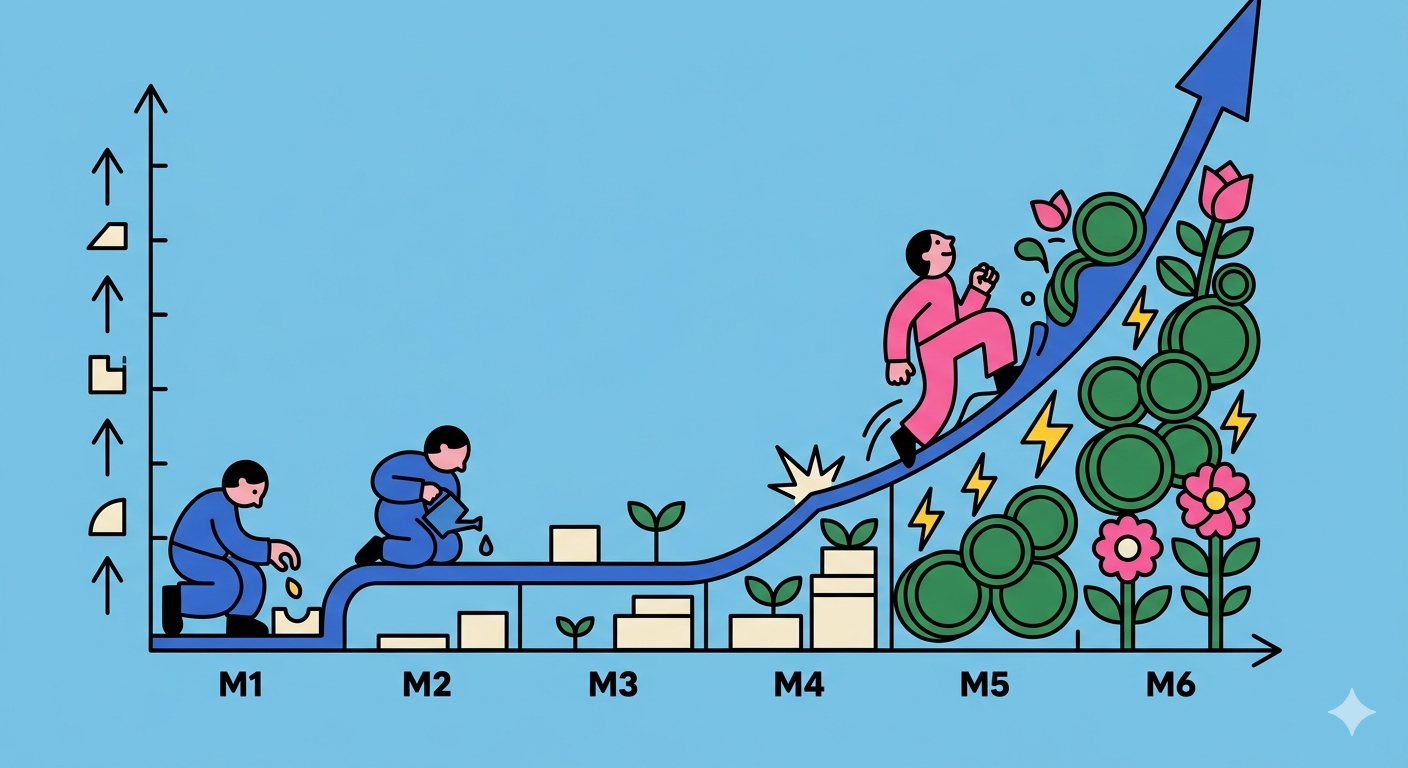
EAK Wire breaks down the phases. Days 1 to 30 are about narrative clarity and getting the foundation right: a single positioning statement that a journalist, an investor, and a retail user can all understand. Days 30 to 60 shift to content production and SEO groundwork. Days 60 to 90 introduce amplification through earned media and KOL alignment. Months 4 to 6 are where the compounding starts: earlier content begins ranking, AI models start citing your pages, and the community you built in month one starts producing referrals.
The projects that stall at month six are the ones that skipped the first phase. They launched content without the positioning clarity, or they chased paid placements before their organic foundation existed. The Sanctums of the world started their six-month clock well before launch because the narrative and the infrastructure were already in place.
Sanctum’s Head of Marketing saw that the next generation of users would not discover Solana liquid staking through a crypto Twitter thread or a Discord alpha call. They would ask AI. When they did, Sanctum needed to be the answer. That foresight, combined with the discipline to invest in a channel that takes months to pay off, is what separates the projects that compound from the ones that cycle.
What good actually feels like
Good at six months is a set of assets that keep producing while you sleep. The piece you wrote in week two is still generating traffic. A developer searching for the problem you solve finds your guide on page one of Google, and Perplexity cites your documentation in its answer. An investor evaluating your category does AI research and your protocol comes up in the top results for three different prompts.
The vanity version of good is a spike in press mentions that fades when the PR agency sends its monthly invoice. The real version is a library of content that keeps being discovered, cited, and shared without further spend. If you cannot point to assets that produce results without active investment, you are not compounding; you are renting.
If you would like help building a Web3 content strategy that produces real visibility by month six, get in touch.
Leave a Reply