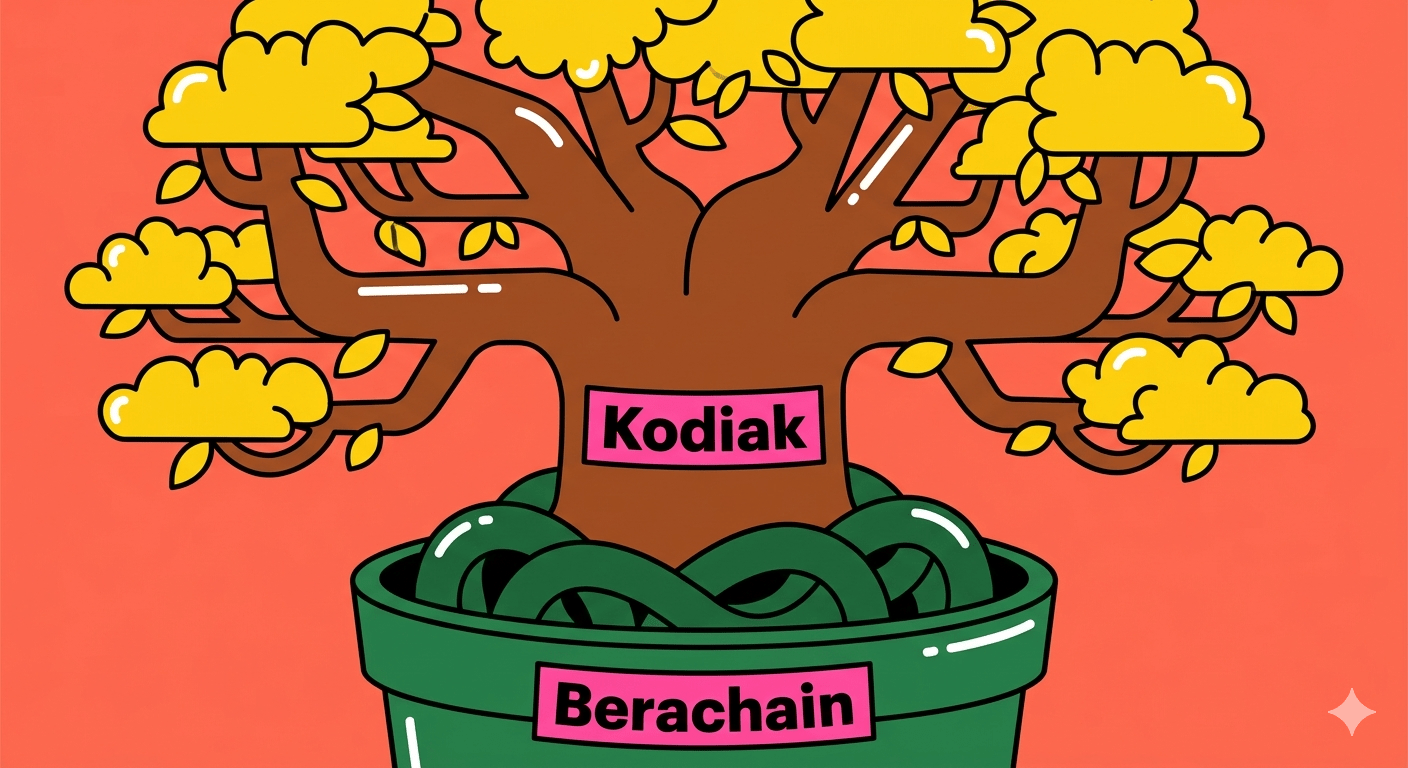
If you run a DEX on a chain that controls 90% of the spot and perps volume, you would think you have won. Your market share is dominant. Your liquidity is the deepest on the network. Your TVL, even after the post-launch comedown, sits at $77.2 million. By any standard measure of product-market fit, you are the market.
But market share on a shrinking total addressable market is not a moat. It is a dependency.
Kodiak Finance went from $1.38 billion in TVL at its April 2025 peak to $28.9 million on its V3 DEX today, according to DefiLlama. That is a 98% decline. And yet Kodiak still claims 90%+ of Berachain’s DEX volume. The percentage stayed constant while the denominator collapsed. That is the single most dangerous metric for any protocol building on a new L1.
When your market share stops meaning anything
The instinct for most Web3 founders when they see 90% market share is to call it a moat and move on. You control the dominant exchange. You have the deepest pools. You are Berachain’s Uniswap. What is there to worry about?
The answer is in the TVL chart. Kodiak V3’s TVL peaked at $1.38 billion in April 2025, then dropped steadily through the rest of the year. By January 2026 it had stabilised around $150 million. By May 2026 it had fallen further to $29 million. CoinGecko data shows KDK’s market cap at $2.76 million against $77.2 million in total protocol TVL, giving it a MCap/TVL ratio of 0.04. That is among the lowest in all of DeFi.
The KDK token did not underperform because the product is bad. It underperformed because the total addressable market shrank. Berachain users pulled liquidity. The airdrop farmers left. The hype cycle ended. And Kodiak had no mechanism to grow its user base independent of the chain’s.
Growth-stage teams building on new L1s make this mistake constantly. They assume the chain’s distribution is their distribution. They build for the wave. And when the wave recedes, they find out their 90% market share is 90% of a puddle.
The islands signal
There is one data point in Kodiak’s numbers that actually tells a positive product story. Kodiak Islands, the automated liquidity management product, now holds $48.2 million in TVL. That is more than the core V3 DEX at $28.9 million. Users are not coming to Kodiak to trade. They are coming to deploy strategic liquidity and walk away.
This matters for two reasons. First, it proves the product has a stickier use case than the swap interface. Passive liquidity management retains capital longer than active trading. Second, it suggests that Kodiak’s real value prop is infrastructure, not exchange. If you are a founder evaluating whether to build on Kodiak as a liquidity layer, the Islands data says yes. If you are evaluating whether Kodiak will be Berachain’s primary interface for retail traders, the V3 data says maybe not.
The revenue question
Kodiak has generated $14.2 million in all-time fees, according to DefiLlama fees data. Most of that was earned in the first three months after Berachain mainnet launched. Current daily fees sit at $2,340. The 30-day annualised run rate is $961,000.
That run rate at a $2.76 million market cap implies a price-to-sales ratio that looks attractive on paper. But the numbers do not compound. The fee trend is driven entirely by Berachain activity levels, which Kodiak does not control. If the chain sees a volume spike from a new airdrop or incentive program, fees go up. If the chain goes quiet, fees go down. Kodiak is a derivative of Berachain’s user base, not an independent growth engine.
Kodiak’s fee breakdown, as documented on DefiLlama, shows that since January 2026, 60% of protocol revenue goes to “token buy back” for KDK, 30% goes to protocol-owned liquidity, and 10% goes to the treasury. It is a well-structured mechanism. But as CoinGecko market data shows, KDK is trading 1.8% above its all-time low of $0.184. At current fee volumes, buybacks have negligible impact.
What this means for Web3 marketing teams
Here is the hard conversation. If your protocol is the dominant application on an L1 that is not Ethereum or Solana, you do not have a moat. You have a single point of failure tied to someone else’s user acquisition.
Kodiak’s situation is not unique. Every chain-native protocol faces the same structural risk. But Kodiak is instructive because the numbers make it visible. A 98% TVL decline with flat market share is a clear signal that your growth is a function of chain activity, not product strength.
The marketing implication is straightforward. You need to invest in content and distribution that grows the chain’s user base, not just your protocol’s. Every piece of educational content about Berachain, every tweet thread explaining why to bridge to the ecosystem, every guide on how to use Berachain DeFi is a direct input to your own user acquisition funnel. If you are building the dominant app and you are not acting as a content engine for the chain, you are letting your only distribution channel atrophy.
Kodiak describes itself on CoinGecko as “a vertically integrated decentralized liquidity platform powering token launches, trading, and advanced liquidity management.” That is an accurate description of the product. But product scope and market position are two different things.
But raw materials are not a strategy. The missing piece is a marketing engine that does not depend on someone else’s growth.
I work with growth-stage Web3 teams who need marketing ownership without hiring a full-time CMO. That means strategy, positioning, content, and channel work structured for the stage you are actually at. Get in touch.
Leave a Reply