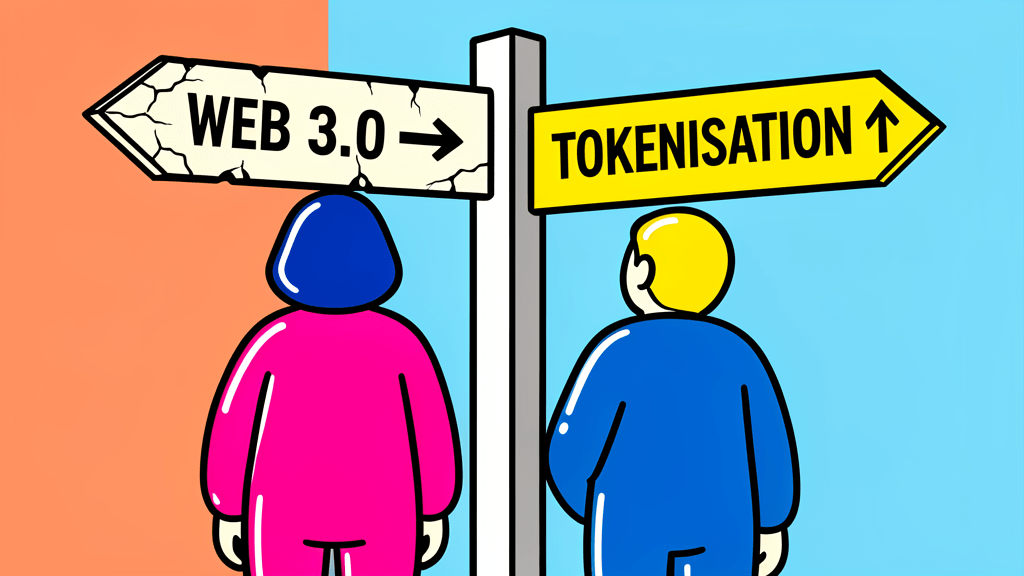
If you still describe what you do as “Web3,” you are marketing something that stopped being an accurate description around the time the GENIUS Act passed.
This is not a “Web3 is dead” hot take. The technology that the term was meant to describe is more economically significant today than it has ever been. What changed is that the term can no longer contain what the industry has become.
The people building the most important things in crypto right now do not call it Web3. a16z crypto, one of the largest investors in the space, uses “onchain,” “tokenization,” and “stablecoins” across their content. Their April 2026 article titled “Why ‘stablecoins’ won’t age well” argues that the term stablecoin itself has outgrown its original label. Robert Hackett, the author, compares it to “horsepower” — a metaphor that stuck long after technology rendered it irrelevant. He writes: “The question is no longer ‘will it hold its value?’ but ‘what else can we build with it?’”
The same logic applies to “Web3” at a category level.
What happened to the term Web3
The word peaked in 2021-2022 as a venture marketing label. It meant “the decentralised internet where users own their data instead of platforms owning it.” It was useful because it described a gap: a version of the internet that did not exist yet. VCs used it to signal thesis alignment. Founders used it to signal category. Media used it as a shorthand for a batch of companies they had not yet learned to distinguish.
By 2023 the term was already fraying. Too many projects that were clearly just crypto startups rebranded as “Web3” to capture marketing tailwinds. Gaming projects, NFT collections, and token-launching platforms all adopted the label. It became less a category and more a flag of convenience.
By 2025 the gap between the label and the reality was wide enough that anyone paying attention noticed. My own post from May 2026, “What is Web3 in 2026”, argued that the term now describes “something narrower and more durable than the decentralised consumer revolution that was marketed during the last bull run.” Reading it back two weeks later, even that feels generous. The term has been hollowed out by overuse and regulatory reality.
What replaced it
Look at the language that actually describes what is being built.
Stablecoin supply grew from $128 billion to $300 billion between 2024 and spring 2026. That category no longer calls itself “Web3 stablecoins.” It is just stablecoins — a $300 billion financial instrument that CoinDesk and the IMF now cover as infrastructure, not as a subgenre of a decentralised internet movement.
Tokenised real-world assets reached $27.6 billion on-chain by April 2026. BlackRock’s BUIDL fund leads at $12.88 billion. The IMF published a paper titled “Tokenized Finance” arguing it represents “a structural shift in financial architecture.” JPMorgan, Goldman Sachs, and Coinbase all launched or expanded tokenisation products in 2025-2026. None of them describe this work as “Web3.” They call it tokenisation.
The a16z content catalog uses categories like “DeFi,” “stablecoins,” “tokenization,” “infrastructure,” and “onchain finance.” Their State of Crypto reports track developer activity, usage metrics, and investment flows — not Web3 sentiment. The terminology shift from firms like a16z is not cosmetic. It reflects a genuine recognition that the industry has moved from a speculative thesis to a measurable sector with specific product-market fit.
CoinDesk, a decade after it started covering this space, now leads with “tokenized assets” and “real world assets” in its article taxonomy. The term “Web3” still appears in their tagline for SEO purposes. Their actual coverage tells a different story.
Why the label matters for your marketing
If you are a founder still introducing your project as “a Web3 [whatever],” you are doing something more costly than using an outdated term. You are signalling that your marketing has not kept pace with the industry’s evolution.
Your audience splits into two groups. People who pay close attention to crypto have already stopped using the word seriously. When they hear “Web3” from a project, they mentally fast-forward past the pitch and wait for you to say what you actually do. People outside the industry either associate the term with the 2021 bull run (speculation, NFTs, scams) or have no idea what it means. Neither group is helped by the label.
The projects that are winning on narrative clarity right now describe themselves by what they actually do. They say “Bitcoin lending protocol” instead of “Web3 DeFi platform.” They say “onchain stablecoin issuer” instead of “Web3 payment infrastructure.” They say “tokenised Treasury fund” instead of “Web3 real-world asset protocol.”
This is not about abandoning a category. It is about recognising that the category has outgrown the name the way stablecoins outgrew “stablecoin.” The term Web3 described a dream. The industry now has revenue, regulation, and real users. That deserves a better label than the dream had.
What to call it instead
I do not have a replacement term, and I suspect there will not be one. The industry will not rebrand to something singular. It will fragment into categories that make sense on their own terms: tokenisation, onchain finance, Bitcoin infrastructure, stablecoin payments, decentralised exchange protocols. Each will develop its own vocabulary, its own media coverage, and its own audience.
The projects that adapt fastest will be the ones that stop trying to explain what “Web3” means and start saying exactly what they do. The label was useful for its moment. The moment is over.
I work with growth-stage Web3 teams who need marketing ownership without hiring a full-time CMO. That means strategy, positioning, content, and channel work structured for the stage you are actually at. If that sounds useful, get in touch.
Leave a Reply